

There comes a moment in an organization when you know deep down: we won’t solve this by scheduling yet another meeting or starting another project group. That moment is rarely dramatic. There is no crisis, no major conflict, no one pounding their fist on the table. It is much more subtle. In small irritations. In overflowing agendas. In people saying they’ll “just squeeze it in as well.”
These are usually the people involved.
And to be honest, I am part of that too.
I am also someone who fills in the gaps. Someone who thinks: this simply needs to be arranged. Who feels that responsibility, even if it is not explicitly assigned. That doesn’t always feel wrong. On the contrary, it gives energy. You help move the organization forward, prevent problems, and keep momentum in a project.
Until you realize that you are actually maintaining something that no longer fits.
Because the same people always step in, and responsibilities implicitly shift without anyone really addressing it, the system keeps running, but beneath the surface it becomes increasingly unclear. Everyone works hard, but no one can exactly explain where the main focus lies or who ultimately makes the final decision.
And then the reflex is often: work even harder. More coordination. More reporting. More emphasis on results. While it is rarely a problem of effort.
What I often see is that the organization has changed, but the way of organizing has not evolved accordingly. What worked well in an earlier phase—short communication lines, a lot of mutual trust, informal decision-making—starts to cause friction as complexity increases. There are more projects, more stakeholders, more dependencies. And without anyone intending it, confusion arises.
That feels like a matter of trust. But often it is primarily a matter of clarity.
Lencioni – and why I started to have doubts
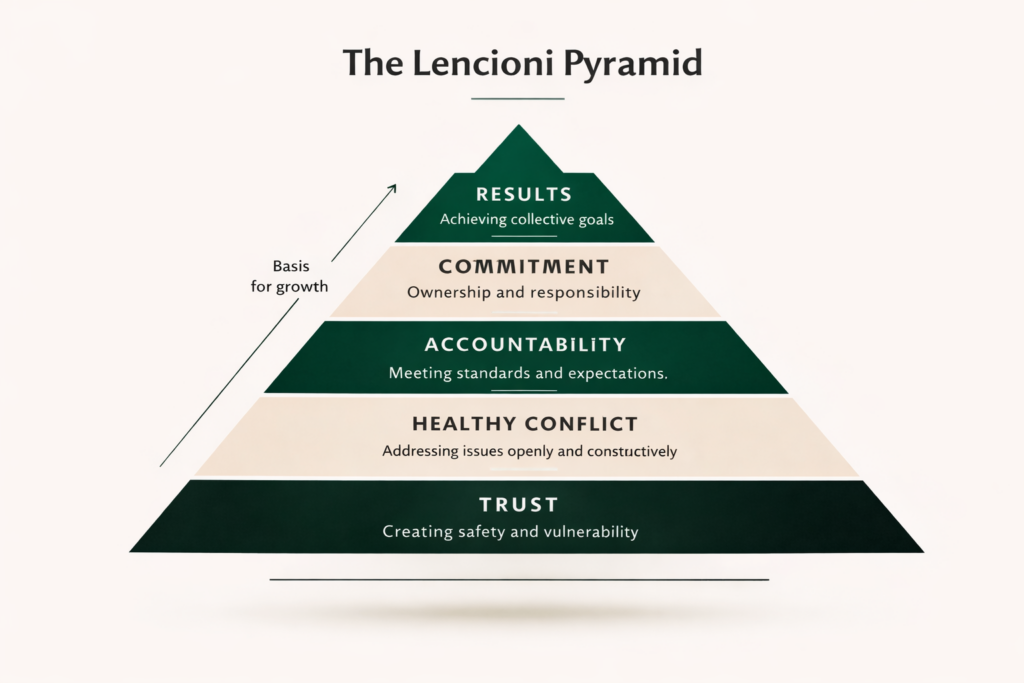
In team development, the Lencioni pyramid is often used. Trust as the foundation, followed by space for conflict, then commitment, next accountability, and finally results. I have often used this concept myself. It is logical and effective.
But recently I saw a post where someone flipped that pyramid upside down. The idea was that you can also start with a shared goal and clear agreements, and that trust then grows through working together. That made me think.
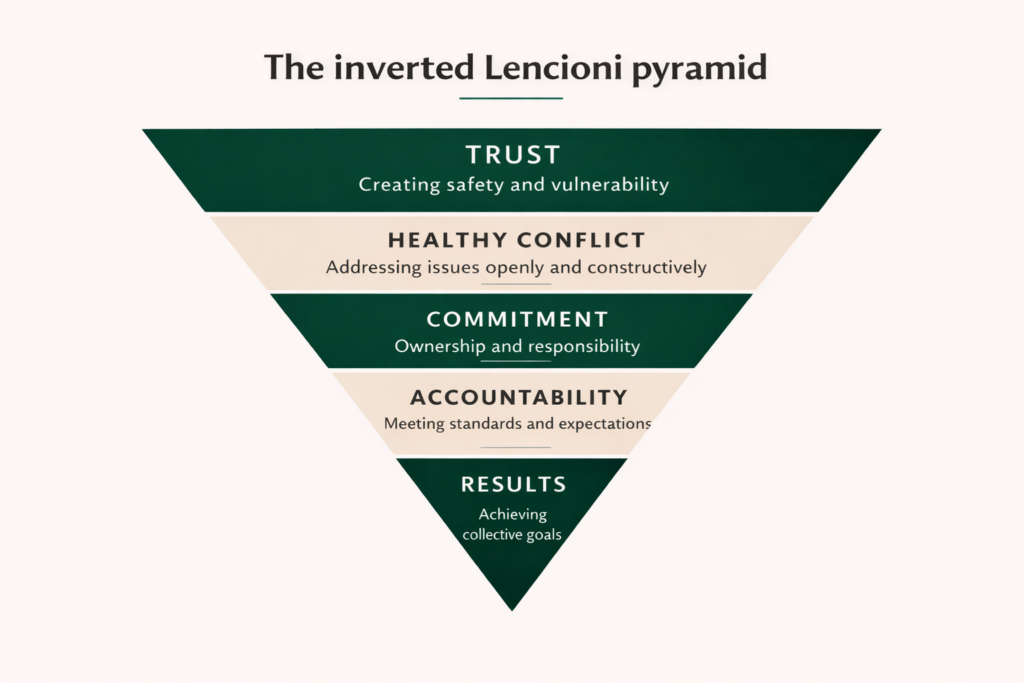
My first reaction was actually resistance. Trust is the foundation, isn’t it? Without trust, you can’t really hold each other accountable. I’ve seen that many times.
And yet, it kept gnawing at me.
In organizations where I was personally involved, I noticed that we kept talking about culture, collaboration, and trust, while the unasked questions were much more concrete. Who is making the decision here? What is truly the priority? Which projects do we stop? Who is ultimately responsible when things get tough?
Perhaps trust sometimes does not grow through talking about it, but because people experience that agreements are clear and consistently upheld. That you know what to expect. That you know what you will be held accountable for – and what you will not.
Maybe trust doesn’t always have to be the starting point. Maybe it can also be the result of clarity.
That does not mean that trust is unimportant. On the contrary. But it shifts the question. Instead of: “do we trust each other enough?”, the question becomes: “have we actually organized it clearly enough?”
That is a less romantic question. But often a more honest one.
What I find difficult about it myself is that it also asks something of me. If I am the one who fills in the gaps, then I am also contributing to maintaining the lack of clarity. As long as I solve it, the system does not have to adjust. That is an uncomfortable conclusion.
Perhaps that is the turning point. Not in working even harder, but in the moment when someone dares to say: this no longer feels right.
Not because people are not doing their jobs well. On the contrary. Often teams work very hard. But when goals, roles, and priorities are no longer clear, energy is lost. Everyone tries to move forward, but not always in the same direction.
When an organization enters a new phase, it is often not helpful to immediately introduce culture programs or additional KPIs. What usually yields better results is a good conversation: where do we want to go, who is responsible for what, and which things are we still doing simply because we have become accustomed to them?
Once that becomes clear, calm returns to the collaboration. Agreements become more predictable, responsibilities clearer, and teams can make decisions more quickly again.
And it often turns out that the problem was never that people weren’t working hard enough.
But that it was time to work more clearly again.