

In many organisations, it is always the same people who step in when things get uncomfortable. The ones who take ownership when decisions remain vague, who fix issues before they escalate and who make sure the customer never notices what is happening internally.
I recognise that well, because for a large part of my career I have been exactly that person.
And to be clear, these are often your strongest people. Without them, projects stall, customers get frustrated and things start to break down. So it makes perfect sense that organisations value this behaviour and even reward it.
But there is another side to it, and you only start to see it when you look a bit further than the immediate result.
The problem nobody really talks about
What I have seen across different roles is that certain discussions and problems keep coming back. Pricing is a good example, but it is not the only one. Responsibilities remain unclear, decisions are delayed or revisited and the same conversations seem to repeat themselves over time.
And every time, the same thing happens. Someone steps in, makes a call, fixes the issue and keeps things moving.
From the outside, it looks like the organisation is flexible and solution-oriented.
But something else is happening underneath.
The underlying issue remains untouched.
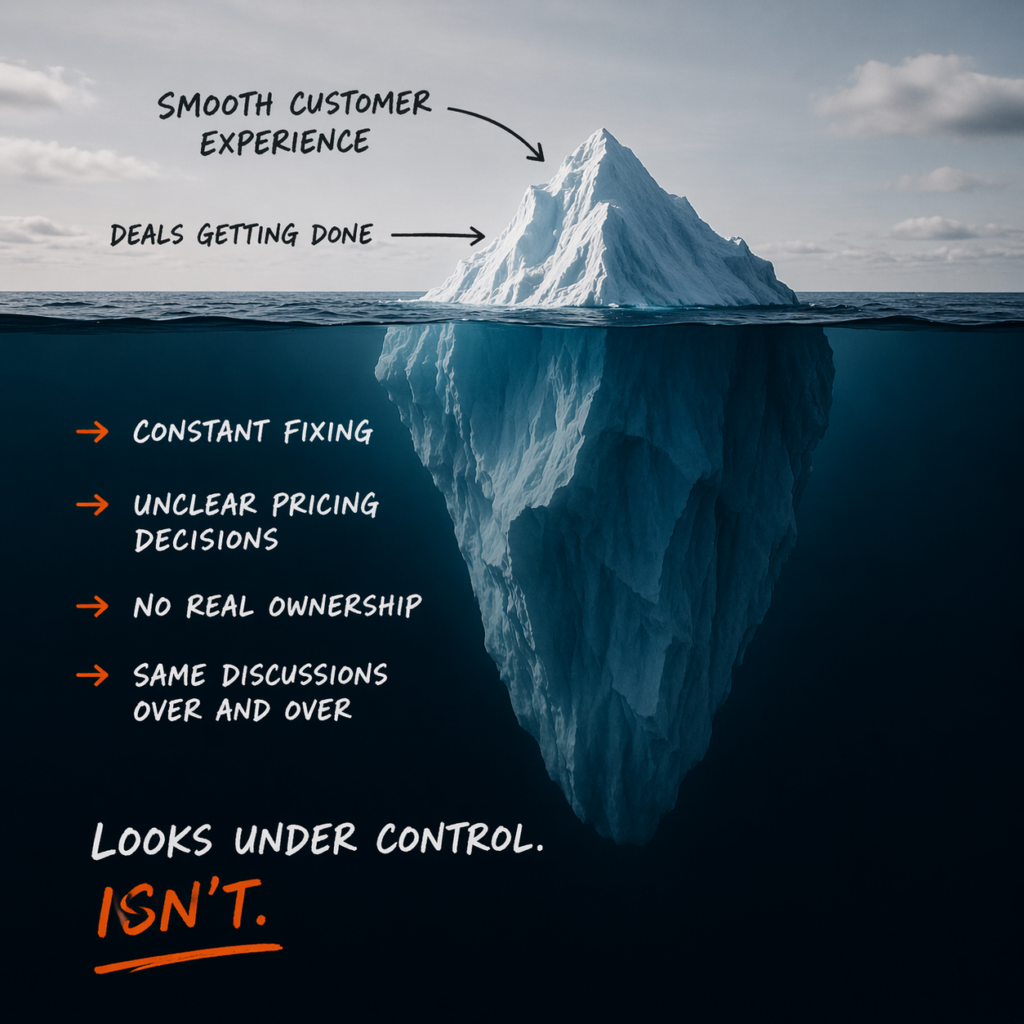
The loop organisations get stuck in
If you take a step back, you start to see a pattern. There is a gap somewhere in the structure, someone fills it, the situation stabilises and everyone moves on.
Because the problem is solved, there is no real urgency to fix it structurally. And so, at some point, it comes back again.
Not because people do not see it or do not care, but because the system is never really forced to change.
This is not an incident.
It is a pattern.
Where this becomes visible in practice
One of the areas where this becomes very visible is pricing.
In theory, it makes perfect sense that different customer segments are approached differently. Customers you want to build with long term require a different approach than more transactional ones. The first group creates stability and volume, even when markets change, while the second group is often more price-driven and opportunistic.
In practice, however, that translation is often not sharp enough.
What happens then is that pricing discussions are handled per customer, over and over again. Not because people enjoy discussing pricing, but because there is no clear structure underneath that provides direction.
This is not an exception. This is what happens when commercial choices remain implicit and are never really made explicit.
And at that point, the same pattern appears again.
Someone steps in, makes a decision, keeps the deal alive and protects the relationship. In the short term, that works. The customer feels treated fairly and the organisation moves forward.
But the real question remains unanswered:
which customers do we actually want to build with long term, and what does that mean for how we price and serve them?
As long as that question is not addressed, pricing remains something you solve per situation instead of something you use strategically.
Why this is more than an internal issue
This is exactly where it becomes bigger than just an internal problem.
Because it directly affects how you operate commercially.
If your pricing and segmentation are not clear, you will inevitably create variation in how customers are treated. That might feel like flexibility, but in reality it often leads to inconsistency.
Customers start comparing, internal discussions keep coming back and decision-making slows down. And maybe more importantly, you slowly lose control over where you actually create value.
Not all at once, but gradually.
The uncomfortable reality
Once you start seeing this, it becomes difficult to ignore.
Because it means that the people who make the biggest difference in your organisation are at the same time helping to keep something in place that you would actually want to change.
The better people are at fixing these situations, the less pressure there is to address the underlying problem structurally.
Not because they are doing something wrong, but because they are simply very good at what they do.
Why this behaviour persists
The difficult part is that this behaviour makes complete sense.
You see someone taking ownership, bringing calm into the situation and making sure customers are helped. That is exactly what you want to see.
So you reward it, you rely on it and over time you even start to build a certain dependency around it.
And that is how the pattern sustains itself.
What it takes to break it
Organisations that do break through this usually do a few things differently.
They shift the focus from solving to preventing. Not the person who fixes the issue is central, but the one who makes sure it does not come back.
They make choices explicit, especially on commercial topics like pricing and segmentation. As long as those remain implicit, the same discussions will keep returning in every individual situation.
And maybe most importantly, they accept that things might feel less smooth for a while. Because the moment you stop fixing everything ad hoc, what has been underneath for a long time becomes visible.
That can feel like a step backwards, but in reality it is the first step towards real improvement.
What this really comes down to
The question is not whether you have people who step in and fix things. You do, and you need them.
The real question is what role they have started to play in your organisation.
Are they helping you to become structurally better, or are they unintentionally making sure certain problems never really disappear?
Closing
As long as you rely on people to fix what the system does not solve, there is no real need to build something better.
That feels efficient and even comfortable, especially in the short term.
But at some point, it starts to show. In discussions that keep coming back, in commercial decisions that are no longer consistent and in an organisation that becomes dependent on a few people who “make it work”.
On the surface, everything can look under control, while underneath the same issues keep repeating themselves.
And that is usually the moment when organisations realise that something more fundamental needs to change.
The only question is whether you want to get there by design, or by necessity.
What sits underneath all of this is a more fundamental question that many organisations tend to avoid: Are you actually serving the right customers in the right way? As long as that is not clear, you will keep solvingper situation instead of consciously steering your business.